| Location |
|
Longdendale |
| County |
|
Cheshire |
| Year demolished |
|
1943 |
| Reason |
|
Pollution of ground water |
|
|
|
| |
|
| The photo printed in . |
| "Annals of Hyde & District" |
| Hall ca. 1640? |
|
|
|
| Robert De Hollyngworthe's |
| planned expansion ca. 1850 |
| (plans never realized) |
|
|
|
| |
|
| The photo printed in |
| J. Adger Stewart's book: |
| Descendants of |
| Valentine Hollingsworth, Sr |
|
|
|
| Colorized version of photo in |
| J. Adger Stewart's book: |
| Descendants of |
| Valentine Hollingsworth, Sr |
|
|
|
| Colorized version of Don Parker's |
| last photo taken of |
| Hollingworth Hall |
|
|
| |
|
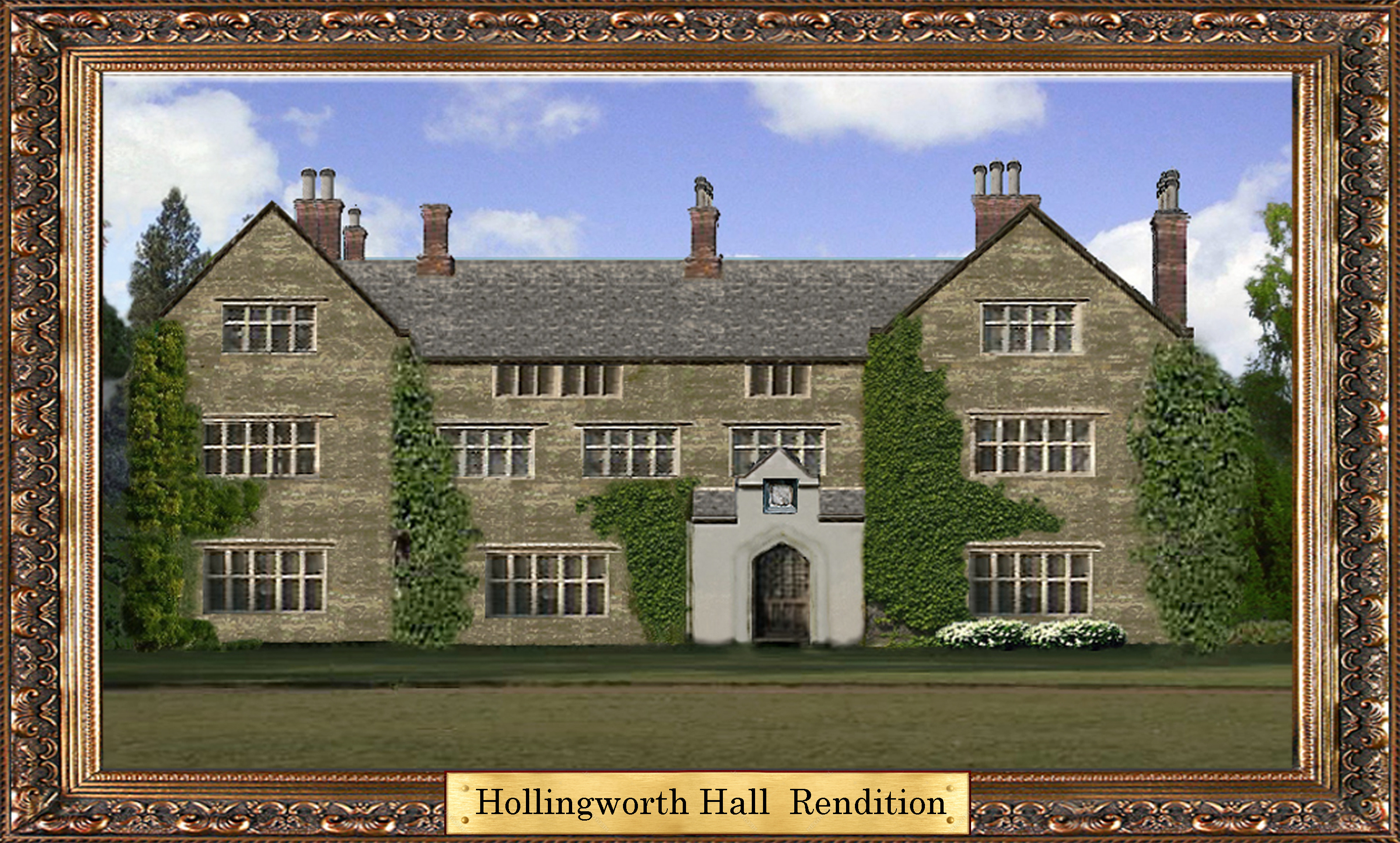
The site of Hollingworth Hall is believed to have first been used for a home sometime after the Norman Conquest, when William I gave land to William de Peveril, who built two hunting lodges, one of which was in Hollingworth. There are references to a hall in 1404 and this property was rebuilt in 1640. Several families lived at the site, off Hobson Moor Road, but the best-known were the de Hollyngworthes, from whom the district took its name. The ancient Longdendale family of De Hollyngworthe was seated in the township of Hollingworth as far back as the reign of King John. Sir Peter Leycester puts forth the theory that this township is the ancient "Holisurde" of the Doomsday survey, included in the description of wasted lands then "held by the Earl," but previously " held by eight free men as manors."
- One branch of this old family terminated in a female heiress about the time of Edward I. Through the reigns of Edward III., Henry IV., and other subsequent sovereigns, the old name, however, figures as owner (another family supposed to be descended from the parent stock). So far the name is spelt in the ancient fashion, De Holynworth, or Hollyngworthe; but in the time of Elizabeth there is a record of Robert Holinworth.
- The Hollingworth family were Lords of the Manor of Hollingworth in Longdendale from the mid-thirteenth century until the early 18th century, and were the most prominent and influential family in the Longdendale area for more than five centuries. The family held two major properties in the area, Hollingworth Hall and the Old Hall and by the late 17th century held almost 700 acres of the surrounding lands including five farmsteads.
- In 1734 the family influence and prosperity declined and its properties passed the remainder of the estate, based on the Old Hall, was sold by the Hollingworth family in 1800 to Samuel Hadfield, later conveyed to Daniel Whitle (before 1831).
- The Whitles conveyed them to Robert Hollingworth in 1831. Robert de Holyngworthe, who claimed to be a descendant of the original Lords of the Manor, was a captain in the 6th Dragoon Guards, with which regiment he served in India. He was a Deputy-Lieutenant for the County, and a magistrate, much respected in Hyde. He died January 31st, 1865. In the Parish Church of Mottram on the north side of the chancel is the family chapel, in one of the windows of which are the Robert de Hollyngworthe arms, crest and motto, richly emblazoned."
- Captain de Hollyngworthe left the estate and hall to his brother Dennis, who sold them the following year, 1866.
- The larger of the estates passed through a variety of hands until in 1924 it was sold to Manchester Corporation Waterworks.
- The Hall was demolished in 1943, having previously served as a school and a mental asylum.
An account of Hollingworth Hall published in 1850: - The Hall, a very ancient structure was partly repaired, and somewhat modernized in the 17th century, but sufficient remains to show that the house has been of no mean pretensions. It was originally quadrangular, and a portion of two towers still remain, and also a mound called the Chapel Hill, upon which the old chapel formerly stood. The passage through the gatehouse or tower has some curious old wood work, on one side, of massive oak, with a side door, and on the outside is one of the slide lights for the porter to examine approaching persons, prior to their admittance. The general appearance of the hall presents a mass of heavy projecting chimneys, gables, and high walls, almost buried in the foliage of the oak, ash and elm. The long old bam is one of the finest of the kind, in the kingdom, standing upon oak blocks, springing from its base, the inside altogether forming a series of arches, and referring to no later a period than the 1st or 2nd Edward. On the north side of the Church of Mottram, is a private chapel belonging to the family, with the arms, etc., in stained glass, in the windows, and on the north door the arms and initials of the family are also ent, which, from the characters and shape of the shield appear to have been executed about the time of Henry VII., or early in the reign of Henry VIII.
- The ancient family of Hollingworth held a manor in Hollingworth for many generations under the Lovells, and afterwards under the Wilbrahams. This estate having been afterwards divided, became two reputed manors. The descendants of John de Hollingworth continued in possession of Hollingworth Hall till the latter end of the last century, when Jacob Hollingworth sold the manor to Mr. Daniel Whittle. It has since come into the possession of the Hollingworth family, and is now the seat and property of Robert de Hollingworth, Esq. ...The Hall is a neat residence, pleasantly situated on high ground, about a mile north east from Mottram Church; it commands a fine view of the vale beneath, and of the bold mountainous district in the county of Derby, in the foreground of which the lofty viaduct of the Sheffield and Manchester railway has a romantic and picturesque effect. The Hall is now the residence and property of the Misses Wood. The OLD Hall is a handsome mansion, 1/2 mile N. from Mottram Church, the seat and property of George Woodhead, Esq.
An account of Hollingworth Hall from the " Manors of England and Wales" [pub. before 1899]: - "The hall is very ancient and retains its original site, and remains of stonework betokening Edwardian origin yet exist; but the general character of the building refers to the period of Henry VI. It was originally quadrangular with chapel, great hall and gate tower, the latter is still remaining. A few relics of ancient armour, old pictures and stag antlers of great size hung upon the walls of the old dining hall, and many of the rooms still retain their tapestried hangings. The arms and initials of a very early date of this family, cut in stone, are built in over the north door of the Parish Church of Mottram, coeval with its erection, and facing Hollingworth."
In 1924 Manchester Waterworks bought the hall for £3,100 and resolved to demolish it as it wanted to eliminate all danger of pollution from the gathering grounds of its chain of reservoirs. Longdendale UDC tried desperately to save Hollingworth Hall but to no avail and it was demolished in 1943. SOURCES:
|
|
| |
Hollingsworth Hall |
| (from DESCENDANTS of Valentine Hollingsworth, Sr.) by J. Adger Stewart |
| The Hollingsworths have held their own all along the ages. They were an old Saxon family said to have settled in the North-eastern part of Cheshire, as early as 1022, in which year the ancestral estate, Hollingsworth Manor, in Cheshire, was purchased. The name represents a locality, from the estate of that name, near Mottram, in the county in question. The name comes from the two words, "holly" and "worth", a farm, meaning a farm of holly trees. Annals dating from the Norman conquest, speak of "the hundred of Macclesfield or Maxfield," known in the Domesday survey as "the hundred of Hamstan," and one of the Manors mentioned in these ancient books is that of Hollingsworth Manor, situated on the edge of the great woods of Macclesfield. The visitation of Cheshire by the official herald in the year 1580 includes "John Hollingsworth, Gent," and "Robert Hollingsworth" among the gentry residing in the hundred of Macclesfield." A further record speaks of Robert Hollingsworth of Hollingsworth Hall, from whom the family is descended, and who was Magistrate for the counties of Chester and Lancaster. |
|
| |
Hollingworth Hall |
(from Ken Hollingsworth's Genealogy Site) |
by Mary Sharrard Johnson & Ronn Johnson |
Hollingworth Hall Farm is located in Hollingworth (near Mottram, outside of Manchester). Coming from Manchester on the Manchester road (A628), turn left onto Green Lane. (It is across from the Methodist Church, which has no sign! Green Lane is also near The New Inn) Continue on Green Lane until it curves...you will see hills....turn left on Cow Lane. Go straight up an unpaved, narrow road. At the top, turn right to Hollingworth Hall Farm. Until we asked for directions at the Mottram Church, none knew where the Hollingworth Hall area was. Don Parker, the overseer of Hollingworth Hall Farm, has a photo of the old Hall before it was demolished. |
|
| |
Hollingsworth Hall (a letter from John Robert Hollingsworth, Sr.) |
Several have asked me if the Valentine Hollingsworth lineage descended from the Hollingsworth Hall family. The answer is.....we do not know. As far as I know, there is no documentation to support this idea and to date, we have been unable to find a documented descendant of the Hollingsworth Hall (or related family) to join us in our DNA project.
I believe Hollingsworth Hall was probably built some time in the 1200's. According to an article that I found in England (no author noted), the Hall was expanded in 1640 and remained much that way until it was demolished. The first record that I have found of a Hollingsworth owner is noted in George Ormerod's History of Cheshire, pub. 1819 and reprinted with additions by Thomas Helsby in 1882. According to this book, ".....John de Holynworth obtained from Henry Payn, chaplain, the manor of Holynworth cum pert. for his life, then to John his son and Ameria his wife, and their heirs." This purchase was made "19 Edward II" or around 1325/26. It remained in the Hollingsworth family until Jacob sold it in 1734 to Daniel Whittle. Captain Robert de Hollyngworthe purchased it in 1831 and lived there until his death in 1865. His brother, Dennis inherited Hollingsworth Manor and sold it in 1866 to Mr. John Taylor. Hollingsworth Manor was eventually sold to the Manchester Corporation Waterworks and unfortunately, Hollingsworth Hall was demolished in 1944.
According to a story that I was told while visiting Hollingworth, the British Army wanted to house troops in the old Hall during WWII. The Hall was in somewhat disrepair and needed new wiring, plumbing, etc. and would have cost the Waterworks a lot of money to update it to be suitable for use as housing again. The Waterworks Committee voted to demolish it rather than spend the money.....I understand that it was demolished very quickly .....before it's demise could be protested. I am attaching copies of Don Parker's photographs of Hollingsworth Hall.
I have received several emails from those thinking about making the "pilgrimage" to Hollingworth, Cheshire. I hope you enjoy the article, and photos. I reduced the resolution of the above photos so that hopefully this update will not overload your mailbox. I will be happy to send you additional information or higher resolution photos if you have a particular interest.
I have been reminded by several of you that our Hollingsworth Surname DNA Project has created a renewed interest in Holling(s)worth genealogy research. We are pleased that we have learned so much and are continuing to learn even more about our early Holling(s)worth lineages. This update is being sent to well over one hundred Holling(s)worth/Hollandsworth/Hollensworth researchers in several different countries.
I hope each of you are enjoying this project.
Very Best Regards,
John of Giles........of Valentine
|
|
| |
Visiting Hollingworth |
Hollingworth Village
from Stockport
Take New Bridge Ln and Stockport Rd W to Hyde Rd/A560/A627 in Bredbury 10 min (2.6 mi)
Follow A560 to Ashworth Ln/B6174 9 min (4.2 mi)
Take John Kennedy Rd to Hyde Rd/A57 in Mottram in Longdendale 3 min (0.6 mi)
Continue on A57 to Hollingworth 4 min (1.1 mi)
Turn right onto Water Ln
The approximate location of the Hall was Northeast of the Village near what is now the intersection of Cow Ln
and Hobson Moor RD. |
Whatever may remain of Hollingworth Hall Park (trees, meadows, etc) is NOT open to the public.
Hobson Moor Road, Hollingworth, SK14 6SQ
Tameside, Greater Manchester |
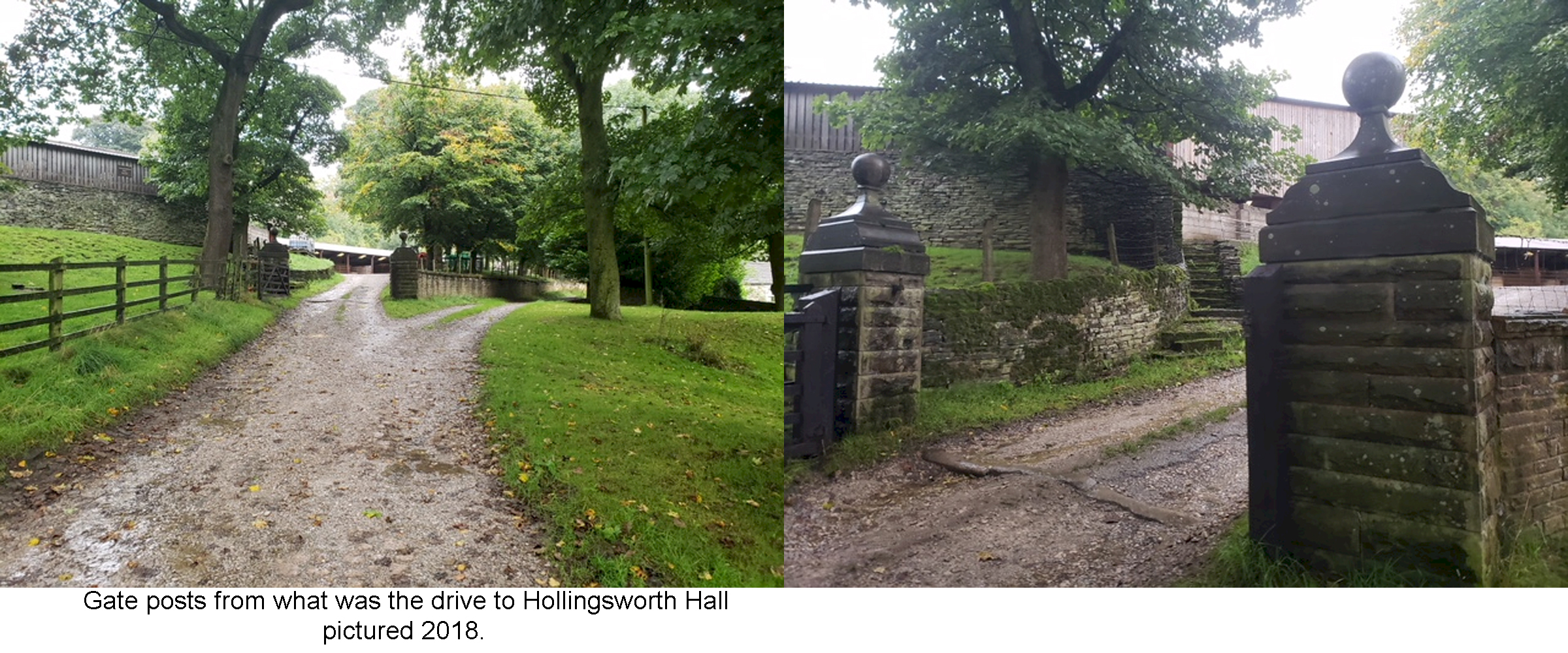
Supposedly Hollingworth Hall Farm was in existence when the Hall was still standing – it is now a private residence.
Hollingworth Hall Farm,
Hobson Moor Road, Mottram,
Hyde, SK14 6SQ |
| Pictures of the J.C. Hollingsworth family visit to Hollingworth (2018) - click on any image: |
 |
 |
 |
 |
|
|
|